Community Corner
Bicycles and You on PCH—Take a Deep Breath
Drivers have many misconceptions about bicyclists.
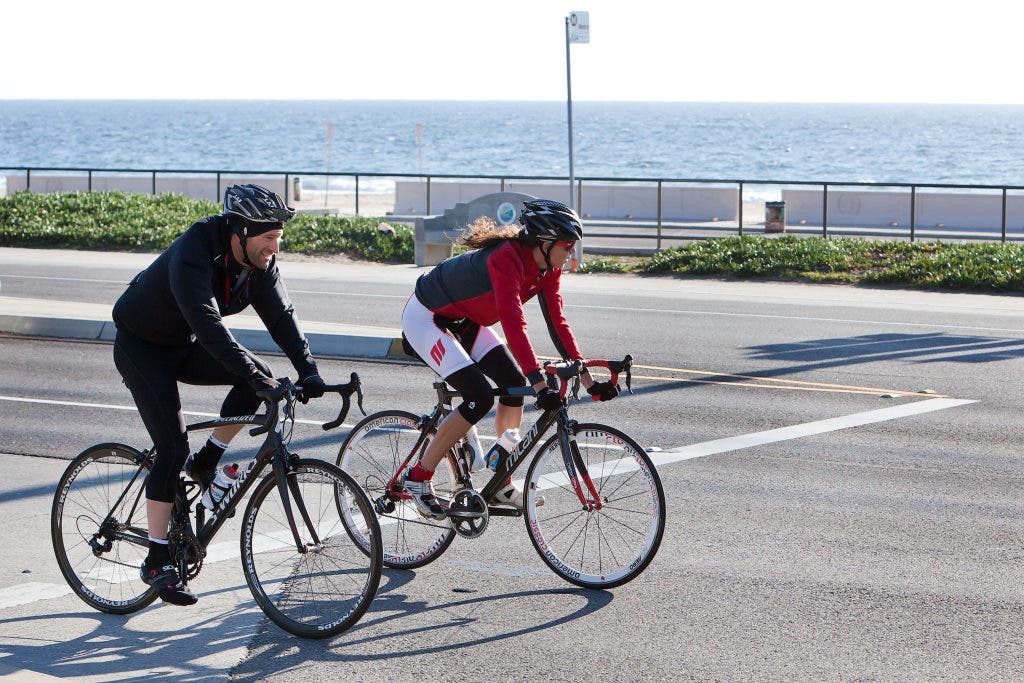
Nearly a year ago, I was frustrated, as were other Malibuites, about the bicycles on Pacific Coast Highway running red lights and riding three-abreast in the right lane. There were other “infractions” that people wrote letters to the editor about. Anger was building, so I came up with the idea of starting a Facebook page called, “Share the Road, Share the Ticket.” Ouch! What brouhaha ensued!
Some people in the bicycle community flipped out, and the blog posts flamed red with anger toward me. I took a licking and kept on ticking, bringing my wounds to the Malibu Public Safety Commission of which I am a member. It turns out fellow Commissioners Chris Frost and Carol Randall had tried to fix the bicycle problems in Malibu for a long time too.
I threw up a white flag and asked the cyclists to have a meeting with me (I was wearing a bicycle helmet and brought my pepper spray). The meeting went well, and from it evolved a bicycle workshop and some great guys I met who have smoothed the way to greater understanding.
Find out what's happening in Malibuwith free, real-time updates from Patch.
The Public Safety Commission held a public workshop this past Saturday to discuss bicycle safety on PCH. Residents, several City Council members and a number of bicycle club members attended the session. It was an eye opener, and we all learned a lot from each other. Afterward, I asked Eric Bruins who bikes to work in Malibu and who attended Saturday’s workshop, to clarify common misconceptions drivers have about bicyclists and explain what it’s like to ride a bike on PCH. He has a lot of knowledge and is happy to post comments clarifying what bicyclists encounter on PCH. We want to hear from you residents too. Tell us your issues and concerns.
Myth: The white lines running down the right-hand side of the traffic lanes are authorized bike lanes.
Find out what's happening in Malibuwith free, real-time updates from Patch.
Fact: PCH does not have bike lanes in Malibu. The white line, known as the fog line, marks the edge between the travel lane and the shoulder. The shoulder is not considered part of the “roadway,” which is defined as the part of the highway ordinarily used for vehicular travel.
Myth: Bicyclists must stay to the right of the fog line at all times.
Fact: Because the shoulder is not actually part of the “roadway,” bicyclists are not required by law to ride on it, although many do so out of courtesy to motorists. The shoulder is full of debris and other hazards that could put a bicyclist at risk, such as broken glass, gravel, rough pavement or parked cars. Many of these hazards are not readily seen from behind a steering wheel. Parked cars are a particular danger because someone may open the door suddenly into the path of a bicyclist, which could lead to a dangerous collision. Many bicyclists stay three to four feet away from parked cars to avoid risk of winning the “door prize.” Often times, avoiding these hazards requires leaving the shoulder.
Myth: Bicyclists are not allowed to ride in the traffic lanes.
Fact: Bicyclists are given all the rights and responsibilities of drivers of a motor vehicle, including the right to ride on the “roadway” (which we already determined does not include the shoulder). The law requires bicyclists to ride “as far right as practicable” except in a number of situations. One of these situations is when the lane is too narrow for a car and bicycle to safely share a single lane. The travel lanes on PCH are too narrow to share in all but a few places, meaning that a bicyclist in the right lane may ride in the center of it. This position is safer for everyone because it increases the bicyclist’s visibility and prevents unsafe passing.
Myth: Bicyclists are allowed to go through red lights at T intersections like Big Rock and Kanan if there is no traffic coming.
Fact: Like a car, bicyclists are required to stop at red lights, even at intersections without cross traffic. Many of these T intersections have crosswalks or driveways that could pose a hazard. On the east end of town, residents use the gaps in traffic to get out of their driveways and garages and are not expecting bicyclists to be there after running the red. That said, no bicyclist has caused a collision by running a red at a T intersection on PCH in at least the last decade.
Myth: Bicyclists do not have to stop at stop signs if there is no opposing traffic.
Fact: Again, like a car, bicyclists are required to stop at stop signs. However, there is no requirement in the California Vehicle Code that they put their foot down (another common myth). Also like cars (but not in a good way), bicyclists tend to slow down, make sure there’s no cross traffic, and proceed without coming to a complete stop. It’s called a California Stop for a reason. The main safety issue arises when anyone one the road—be it a bicyclist or a driver—does not respect the right-of-way of the other person, leading to a potential conflict.
Myth: Bicyclists must use the right-turn lane to stop at a light even if they are going straight in order to stay out of traffic.
Fact: According to the vehicle code, bicyclists are supposed to be in the through lane unless they are turning, just like any other vehicle. Due to the configuration of the shoulder and right turn lanes on PCH, most bicyclists continue on their line instead of merging over into traffic. What seems to work best is for through bicyclists to ride along the left edge of the right-turn lane. Bicyclists must not ride through an intersection from the right side of the right turn lane. This creates a “right hook” conflict between the bicyclist and turning vehicles where the driver turns across the path of the bicyclist. Drivers merging into the turn lane should signal and look for bicyclists in their mirrors and blind spot before turning.
Myth: Bicyclists stay in packs and ride side-by-side because it is safer.
Fact: This is pretty much true. In addition to being social and aerodynamically efficient, riding in a pack increases visibility to drivers—the number one factor in preventing collisions. As we covered above, bicyclists are allowed to ride in the center of a narrow lane at their discretion. Once a bicyclist is in middle of the lane, there is no difference under the law between riding side-by-side and single-file. Either way, a driver will have to change lanes to pass legally and safely.
Myth: Bicyclists must get out of a car's way if the driver is going faster.
Fact: Just as when approaching a slower car, the responsibility is always on the overtaking driver to pass safely. There is a common belief that bicyclists may not “impede” traffic, however the legal definition is much narrower than most people realize. On a two-lane road, the law requires slower vehicles to use turnouts or safely pull over when five or more cars are behind. On a road like PCH, where there are two lanes in each direction, it is always expected that faster traffic pass using the left lane. If there is another vehicle in the left lane, then one should slow down and merge when it is safe to do so. Drivers: Always, always, always, leave at least three feet between your car and a bicyclist.
Myth: Most bicycle accidents are the bicyclist's fault.
Fact: Of bicycle-vehicle collisions on PCH, three out of four are the driver’s fault according to a 5-year study of traffic data from the California Highway Patrol. The most common collisions are sideswipes, right hooks and left crosses (turning left across a bicyclist’s path). These are all avoidable if drivers pass with at least three feet of room, signal and remember to check their mirrors and blind spots. The comparatively few collisions that are the bicyclist’s fault are usually when a bicyclist is riding against traffic or intoxicated. Other factors may include riding at night without lights, failing to signal or failing to observe right-of-way.
Myth: Sheriff’s officers do not ticket bicyclists.
Fact: Bicyclists can and do receive citations for vehicle code violations, just like drivers. Sheriff’s officers are required to enforce the law equally, without favoring any one group over another. However, limited resources require that the officers focus their efforts on violations that are most likely to lead to serious collisions, such as speeding, distracted driving, and driving under the influence. As a result, less serious violations, whether by cyclists or drivers, may sometimes be overlooked under some circumstances.
Please leave your questions below in the comments section, and our bicycling friend will do his best to answer them.


